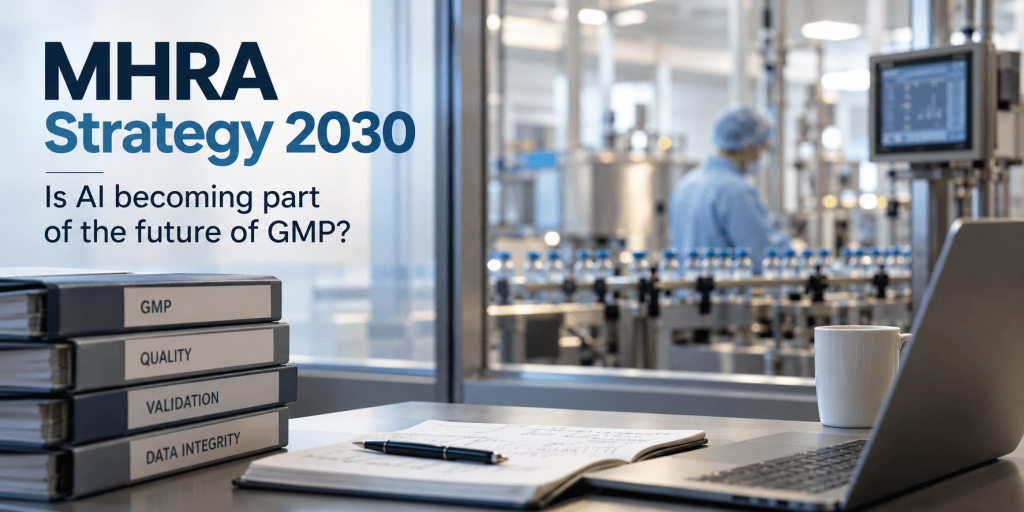
The MHRA has outlined its ambitions for artificial intelligence across the medicines lifecycle. But what does this mean for pharmaceutical manufacturing and GMP compliance?
On 14 October 2026, the MHRA published its Strategy 2030, outlining its priorities for the coming years. Artificial intelligence features prominently, reflecting its growing role in drug discovery, clinical development and healthcare. However, something caught my attention: the MHRA also recognises the challenges that emerging technologies, including AI, bring to pharmaceutical manufacturing oversight. This does not introduce new GMP requirements, but it gives us an indication of where the regulator intends to go.
What has the MHRA announced?
The strategy includes a commitment to publish an AI Medicines Development Action Plan in 2027 and indicates that AI considerations have already been incorporated into Chemistry, Manufacturing and Controls (CMC) regulatory frameworks. However, it does not establish detailed expectations for validating individual AI applications in GMP manufacturing or pharmaceutical quality systems.
This distinction matters. A regulatory strategy indicates direction, not necessarily new legal obligations. Manufacturers must continue to assess AI applications against existing GMP requirements, including validation, data integrity, quality risk management and accountability.
Why might manufacturing be moving more cautiously?
Many recent pharmaceutical AI announcements focus on research and clinical development. Why do we hear comparatively less about implementation in manufacturing and GMP quality systems?
One possible explanation is the nature of the environment. AI can support exploratory research without necessarily influencing regulated decisions. In GMP, introducing AI into an established, validated process may require substantial assessment and change control. Clinical development is, of course, also highly regulated, particularly where AI influences patient safety.
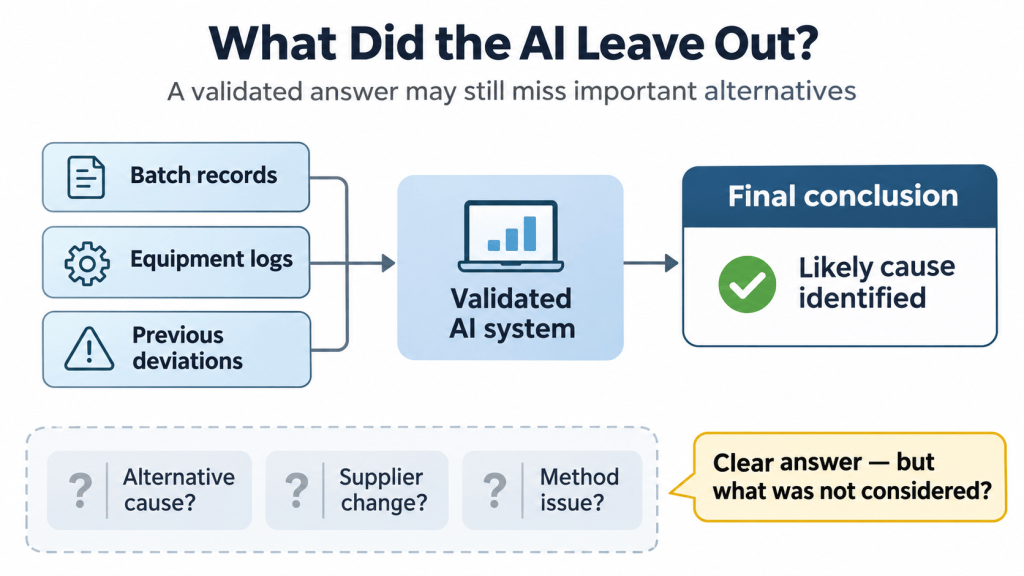
Consider an AI system reviewing deviations and proposing root causes. It could accelerate investigations and identify recurring problems, but how do we demonstrate that its conclusions are reliable? What happens when it makes a convincing mistake? And how do we maintain control when the underlying technology is managed by an external provider?
These are not reasons to avoid AI, but they help explain why implementation may require greater caution.
Where might AI gain traction first?
I would expect adoption to develop at different speeds depending on the intended application.
Potentially more accessible applications include document retrieval, SOP searches, regulatory intelligence, deviation trending, data analytics and drafting investigation reports.
Applications requiring greater scrutiny include batch certification support, OOS disposition, change-control approval recommendations, product release decisions and critical manufacturing process control.
These are not formal regulatory risk categories. Even document retrieval could become critical if incorrect information influences a GMP decision. What matters is the intended use, the consequences of failure and the effectiveness of the controls.
What about the people behind the decisions?
From a QP and quality management perspective, I find human oversight particularly interesting. The risk is not necessarily that AI will replace quality professionals, but that experienced professionals may gradually become overly reliant on AI-generated conclusions.
Imagine an AI producing a convincing deviation investigation, supported by apparently relevant evidence and a proposed root cause. The reviewer may naturally give considerable weight to that conclusion. But has the evidence been independently assessed, or has the reviewer simply confirmed that the AI’s explanation sounds reasonable?
Having a human involved is not necessarily the same as having meaningful human oversight. The QP retains statutory responsibility for batch certification, while other quality approvers remain accountable within their assigned authority. AI does not remove those responsibilities, but it may change how professional judgement is exercised.
Are regulations keeping up?
The proposed revisions to EU GMP Annex 11 and the draft Annex 22 show that regulators are examining how existing expectations should evolve to address AI. These are still proposals, not requirements already in force.
This raises another interesting consideration. Could regulatory uncertainty influence when companies decide to implement AI? Might some organisations accelerate suitable projects while the regulatory framework is still evolving, anticipating that future expectations could become more demanding?
That is possible, although we should not assume it is happening without evidence. Implementing AI before new requirements become applicable would not automatically protect an organisation from future compliance obligations. Nor would it remove the need to comply with existing GMP principles.
The MHRA’s planned 2027 action plan may offer further clarity, but its practical implications remain to be seen.
Looking towards 2027
I see the MHRA Strategy 2030 as a useful signal that AI is becoming part of the regulator’s longer-term vision, including manufacturing oversight. For pharmaceutical companies, this may be an appropriate time to evaluate suitable applications while ensuring that validation, data integrity, meaningful human oversight and accountability remain central.
Perhaps the challenge is not simply deciding whether AI should enter GMP environments, but understanding where it can genuinely improve pharmaceutical quality without creating risks that we are not yet equipped to manage.
And this brings me back to a question: are pharmaceutical companies adopting AI where it creates the greatest value, where it is easiest to implement without challenging established regulatory structures, or is the prospect of tighter future regulation also influencing how quickly they act?



Leave a Reply