
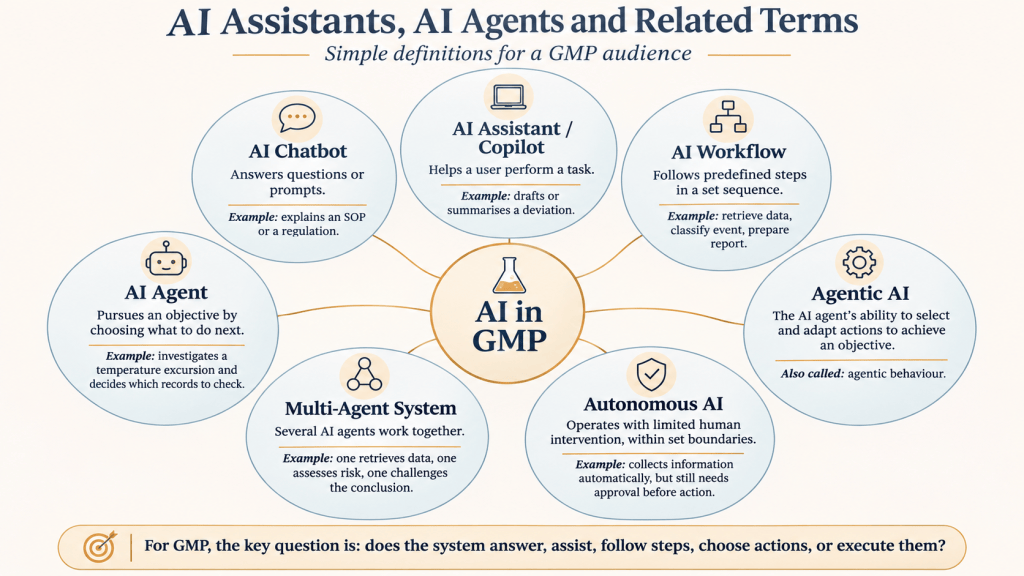
A few posts ago, we reviewed the basic differences between AI, machine learning, deep learning and generative AI. Well, as you might imagine, there is much more. So the next step is
- AI assistants,
- copilots,
- AI agents,
- agentic AI and
- multi-agent systems.
Are these genuinely different technologies, or just different names for something similar? Some terms describe different capabilities, while others overlap or are used inconsistently. For the pharmaceutical industry, understanding these differences is useful because the way an AI system operates can be just as important as the technology behind it.
From answering questions to performing tasks
An AI chatbot is probably the most familiar example. We ask a question, and it provides an answer. Someone working in GMP might ask it to explain an SOP or summarise a regulatory document. The interaction is mainly reactive: we ask, it responds. There is an important distinction here. Asking a chatbot to explain a publicly available regulation does not automatically require a validated GMP system. However, uploading confidential SOPs or relying on AI outputs to perform regulated activities is another matter. Appropriate company approval, controls and, where applicable, validation are needed. I my opinion I would be surprised if a number of GMP workers were not already using public AI tools for work or GMP related questions. Should they? I would love to know how many GMP related questions are being asked around the world every day and at which purpose.
An AI assistant, sometimes called a copilot, can go further. It may help us draft documents, retrieve information or complete specific tasks. For example, an assistant could prepare a draft investigation summary for a Quality professional to review. Here, we are moving closer to a GMP regulated activity. Such use would require appropriate controls and validation based on its intended use and associated risks. The fact that a human reviews the final draft does not, by itself, remove those expectations.
An AI workflow is slightly different. It follows a predefined sequence of activities, with AI supporting one or more steps. Imagine a system that extracts information from a deviation, categorises the event, searches for similar cases and prepares a report. Unlike a chatbot, such a workflow would normally need to be configured or integrated into the company’s processes. Even if commercially available, its suitability and validation would need to be established for the intended GMP use.
An AI agent introduces something more interesting: the ability to pursue an objective by selecting actions rather than simply following a fixed sequence. The key difference with a workflow is who decides what to do next: the predefined workflow or the AI itself. Suppose we ask an AI agent to investigate a temperature excursion. Instead of following only predetermined steps, it might decide to retrieve temperature records, consult stability data, search previous investigations and identify missing evidence. Based on what it finds, it could select which source to consult next.
Agentic AI and multi-agent systems: what changes?
This brings us to agentic AI, which, in simple terms, describes an AI agent’s ability to select and adapt its actions to achieve an objective. This is commonly referred to as agentic behaviour.
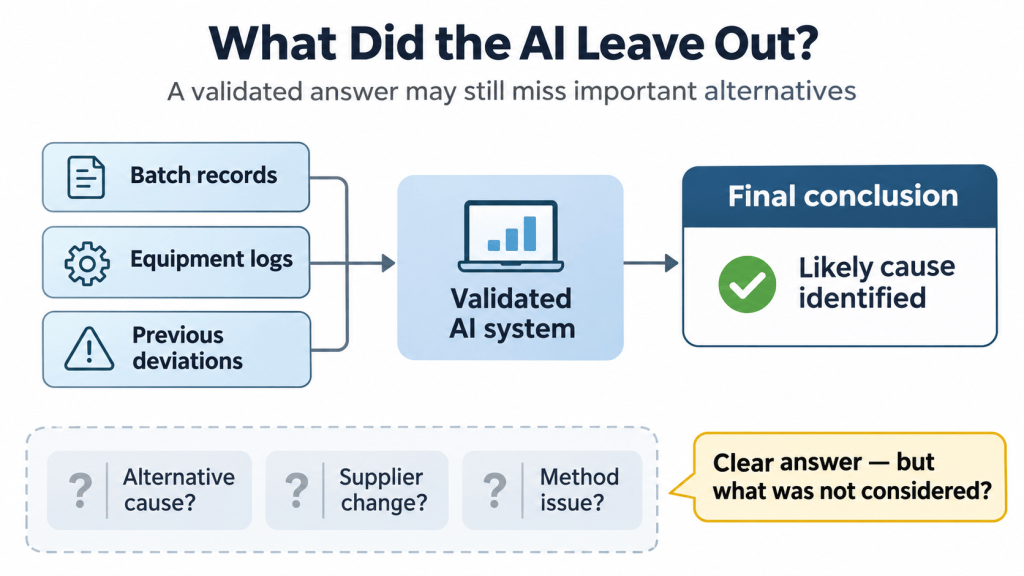
A multi-agent system involves multiple agents working together, each potentially having a different responsibility. For example, one agent might retrieve historical deviations, another assess product quality information and a third challenge the conclusions. Together, they could produce an assessment for human review. This is similar to the concept explored in our article, Sycophancy: The Risk of Our Flattering AI, where we considered a tribunal of AI agents examining an idea from different perspectives. That tribunal was a simulated illustration rather than an operational multi-agent system.
Autonomous AI, meanwhile, describes how independently a system operates. An agent might collect and analyse information autonomously but still need human approval before modifying a GMP record.
You may also encounter Retrieval-Augmented Generation (RAG). Despite the complicated name, the idea is relatively simple: before answering, AI retrieves relevant information from an external source.
For example, a GMP assistant using RAG could search a controlled repository of approved SOPs and use the retrieved information to answer a question. This may improve relevance, but does not guarantee accuracy or remove the need for controls.
Tool use means AI can interact with other applications, such as searching an authorised database. AI orchestration refers to coordinating different tools, tasks or agents within a larger process.
These are supporting capabilities rather than entirely separate categories of AI.
Why should we distinguish between them?
These concepts are not necessarily stages of technological evolution, and more autonomy does not automatically mean better AI. An AI agent may use a large language model, but it does not necessarily have to. Similarly, generative AI focuses on producing content, while agentic AI focuses on achieving objectives through actions. The two can work together.
For GMP, perhaps the most useful distinction is therefore not the name given to a system, but what it is actually capable of doinglike:
- Does it answer questions?
- support activities?
- select actions?
- execute them?
Understanding that difference is a starting point for assessing how the system should be designed, controlled and used in a regulated environment.



Leave a Reply