
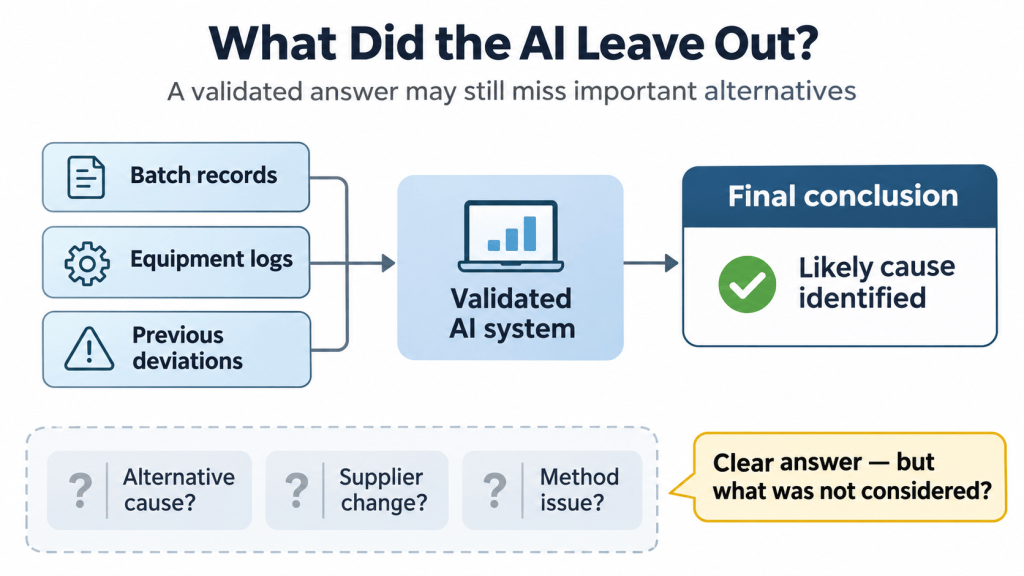
It is undeniable that AI could support a GMP deviation investigation. It reviews batch records, equipment logs and previous events, then produces a convincing assessment. Most likely I would predict that the outcome would seems reasonable and the evidence/reasoning provided would look relevant. Yet, if I was to raise a question, that would be: did the system not bring to our attention?
We established that validation can involve a team of professionals. Quality professionals bring the GMP knowledge needed to judge its intended use, risks and acceptance criteria. But how many of us working in Quality really understand the technical implications of one AI model being selected over another? We may approve validation documentation without being fully equipped to challenge every design choice. That is not an argument for turning QA into data scientists; it is an argument for ensuring the right expertise is brought together, with difficult questions genuinely understood.
Different approaches carry different limitations.
A rule-based system can miss situations its rules never anticipated.
A machine-learning model trained on imbalanced data may struggle with rare deviations or changing conditions.
A large language model may produce persuasive but unsupported explanations, or omit information from lengthy records.
They do not make automatically a system unsuitable. They do, however, influence what must be tested, monitored and explained. A successful validation demonstrates fitness for a defined intended use under assessed conditions; it cannot prove that every relevant possibility will always be considered.
Now imagine the AI suggests that an unexpected assay result is most likely due to a sampling error. It summarises the supporting evidence clearly. But what about a subtle equipment trend, a recent supplier change, or a problem with the analytical method? Perhaps those possibilities were assessed and rejected. Perhaps they were never recognised. A polished conclusion does not tell us which.
When a multidisciplinary team investigates the same issue, members may propose explanations, challenge each other, consider a remote possibility before deciding it is unlikely. The discussion takes time, but it also creates opportunities to notice details that do not fit the leading theory. If significant alternatives and the reasons for rejecting them are documented, the decision can be examined later. Of course, human teams also overlook evidence, suffer from confirmation bias and fail to record their reasoning. Equally, a properly designed AI system may provide better traceability than an inadequately documented human discussion. The important distinction is therefore not between human and artificial intelligence, or how much time each spends, but whether the reasoning and the challenges behind a decision can be meaningfully examined.
We could ask AI to list alternative hypotheses, relevant data, uncertainties and reasons for excluding each possibility. That would help, but there is are limits:
Too much to analise losing track of what is important
For some models, like generative AI, can we have a faithful record of everything the model actually considered .
Current Annex 11 already expects risk-based validation and cooperation between the relevant functions, while ICH Q9(R1) provides principles for assessing and accepting quality risks. These are not entirely new regulatory concerns introduced by AI. What AI may change, however, is the difficulty of recognising what has not been considered, particularly when a validated system produces a coherent and apparently exhaustive answer.
If an AI-supported GMP decision is questioned six months later, will we be able to explain not only why we accepted one conclusion, but how we dealt with the important alternatives that never appeared in the final report?



Leave a Reply