A simple introduction to different AI technologies, and why understanding their differences matters in pharmaceutical manufacturing and quality.
We often talk about Artificial Intelligence as one technology. But AI can work in very different ways and present different challenges when we try to control it. Some systems follow what they have already learned without changing. Others continue learning from new information, while some may produce different answers even when asked exactly the same question. These differences are particularly important in pharmaceutical manufacturing and quality systems, where decisions must be understood, justified, documented and controlled.
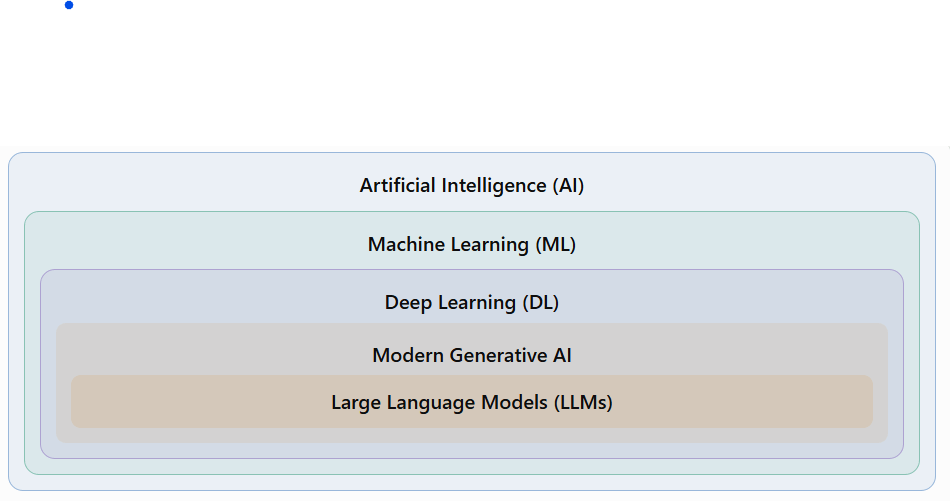
So what are these differences? First, I would start with four different categories that are connected, one inside another, like a set of pots stacked together: Artificial Intelligence (AI), Machine Learning (ML), Deep Learning (DL) and Generative AI (GenAI).
AI is the broadest category. It describes computer systems capable of performing tasks normally associated with human intelligence, such as recognising images, understanding language or making predictions.
ML is a subset of AI that learns patterns from data rather than relying only on predefined instructions. Think about spam emails. Instead of programming every rule for identifying spam, we show the computer thousands of emails already classified as spam or legitimate. It learns the patterns and uses them to classify new emails.
ML can be trained in three main ways:
- Supervised learning (learning with a teacher): The system learns from examples with known answers. Imagine providing historical GMP deviations already classified as minor, major or critical. The system could then suggest classifications for new deviations.
- Unsupervised learning (finding patterns independently): The system identifies similarities in data without predefined answers. For example, it could analyse manufacturing deviations and discover recurring problems that investigators had not previously connected.
- Reinforcement learning (learning by trial and error): The system learns through rewards and penalties. For example, an AI could test manufacturing parameters in a simulation and learn which settings produce the best results within defined quality limits.
DL is a subset of machine learning that uses artificial neural networks with multiple layers to learn complex patterns. For example, it could identify defects in photographs of pharmaceutical tablets.
Generative AI (GenAI) uses models, commonly based on deep learning, to generate new content such as text, images or other data. For example, it could generate a first draft of a deviation investigation or create simulated images of defective tablets to support training.
Large Language Models (LLMs) are one important type of Generative AI, trained on large amounts of text. They can generate language, answer questions and summarise documents. This probably explains why ChatGPT was introduced with such a descriptive name. Not long ago, being able to chat with AI was itself something remarkable. Now, interestingly, we seem increasingly interested in making AI appear more human.
But back to LLMs. They can be used to summarise deviation investigations, review documents or prepare initial drafts of Product Quality Reviews.
From a GMP perspective, these distinctions are useful because different technologies may introduce different challenges. A system identifying defects in tablet images may need to demonstrate how reliably it recognises defects, while an LLM drafting a deviation investigation may need controls to ensure that the information it generates is accurate and supported by evidence. However, the technology alone does not determine the risk. What matters is also how the system is used, what decisions it influences and what happens if it makes a mistake. Coming back to the different technologies, their relationship can be represented, in a simplified way, as:
AI → Machine Learning → Deep Learning → Generative AI → LLMs
This represents how many modern AI technologies are connected, but it is not a strict hierarchy. Most modern Generative AI uses deep learning, although other generative approaches also exist. However, just because an AI system was trained using machine learning does not mean it continues learning during use. Some models remain unchanged after training, others continue learning, and some can produce different answers without changing at all. This brings us to another important question: how do AI systems behave after they have been developed?
Some remain static, others adapt over time. Some produce the same output under the same conditions, while others use probabilities or may generate different answers even when given identical inputs.These are not necessarily separate categories of AI, but different characteristics that can coexist within the same system. And this is where things become particularly interesting for GMP. Understanding the type of AI we are using is helpful, but understanding how it behaves, what we are asking it to do and what happens if it gets something wrong may be even more important.
If AI systems can behave so differently, how can we establish and maintain the level of control expected in GMP, particularly when the same system may continue learning or produce different answers to identical questions? Can we state that we have clear ownership and accountability?



Leave a Reply